Interview
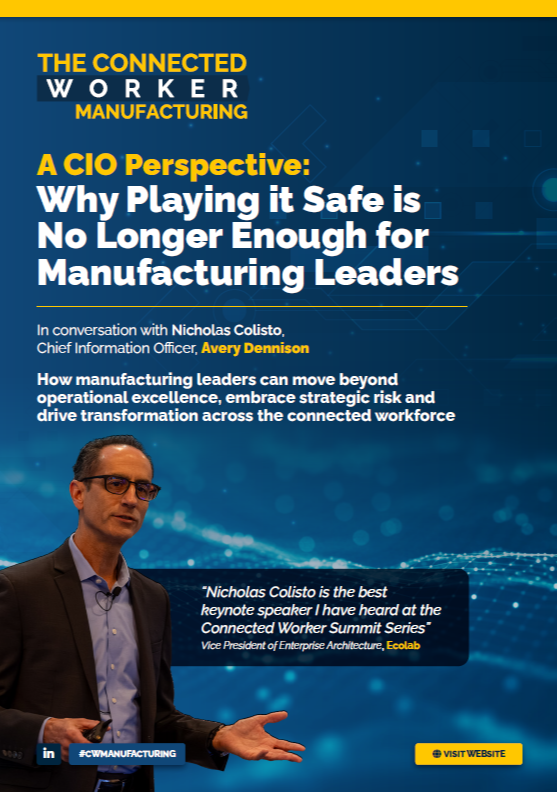
A CIO Perspective: Why Playing it Safe is No Longer Enough for Manufacturing Leaders
"Operational excellence alone eventually stops differentiating you - stability simply becomes expected," Nicholas Colisto, Chief Information Officer, Avery Dennison.
As AI, automation and connected worker technologies reshape manufacturing, leaders must balance innovation with governance while continuing to drive measurable business outcomes. In this exclusive interview, Avery Dennison's CIO, Nicholas Colisto, shares his perspective on leading transformation, embracing strategic risk and enabling enterprise-wide change.
Download the exclusive interview to discover how Avery Dennison is:
- Creating a culture of experimentation without compromising governance
- Turning frontline insights into enterprise-wide transformation opportunities
- Balancing AI innovation with responsible risk management
- Moving technology leadership from operational execution to strategic business impact
- Building stronger feedback loops between technology and frontline teams

Implementing Connected Worker at Duravant
The technology landscape is ever evolving, ushering significant changes for the Connected Worker across varying industries and organizations. With the availability of generative AI and numerous software solutions the industry now has at their disposal, implementation can be challenging, especially across large enterprises like Duravant.
Having acquired multiple companies and businesses over a span of 10+ years, Duravant has established itself as a leader in the industry and the manufacturing sector. However, implementing a Connected Worker program across a diverse pool of companies and cultures poses its unique set of challenges and obstacles. Something as simple as harmonizing Microsoft Teams and looking up employees in an “Address Book” across the enterprise poses complexities.
In this interview with Patrick Quint, Chief Information Officer at Duravant, we explore how the company is navigating and leveraging technology to improve their Connected Worker program, and how they are actively integrating diverse operations and acquisitions into their enterprise to enhance collaboration and efficiency.

Enpro’s Journey towards Human Driven Digital Transformation: Digital Upskilling and the Connected Worker
Advancements in digital technology offer radically new ways of working that can improve efficiency, reduce downtime, and optimize manufacturing operations. However, the adoption of technology comes with its own set of challenges. One of the biggest challenges facing the manufacturing industry is a labor shortage.
A recent study by Deloitte and the Manufacturing Institute, found that up to 2.1 million US manufacturing jobs could go unfilled by 2030, costing the economy a whopping $1 trillion dollars annually. Part of the problem is a skills mismatch. On one hand, manufacturing workers are losing jobs to automation, even as manufacturers find it tough to hire enough people to do the work they need doing.
That’s why manufacturing organizations need to do more to upskill their existing workforce, argues Hao Dinh, Vice President of Technology at Enpro Industries.
In this interview, we spoke with him about the various challenges facing digital upskilling and the Connected Worker, and what industry leaders must consider when driving digital transformation initiatives. His advice on how to digitally upskill your existing workforce offers promising insights and solutions.
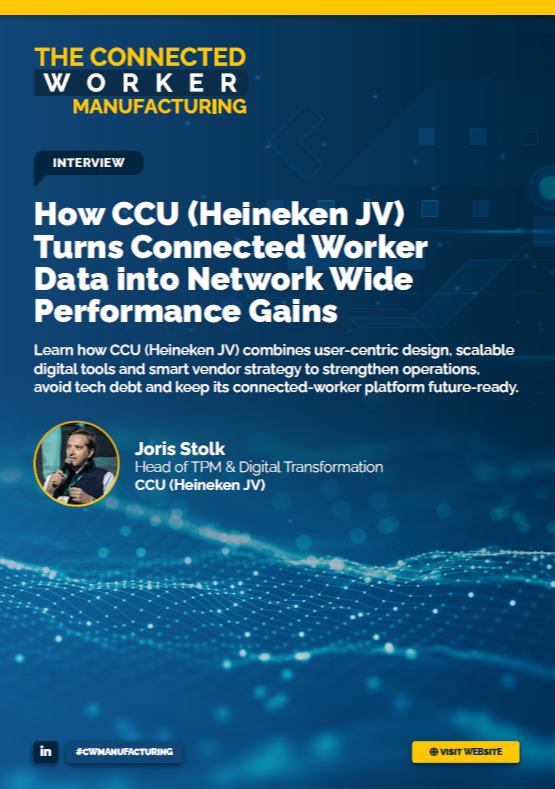
From 1 Brewery to 200+ Sites: How CCU (Heineken JV) Scaled Operational Performance
Joris Stolk, Head of TPM & Digital Transformation at CCU, Heineken's joint venture in Latin America, discusses how the company is future-proofing its connected worker strategy, scaling digital tools across 200+ sites while avoiding long-term technical debt. Drawing on his experience leading the Digital Pilot Brewery, he explains how CCU is building a flexible, user-driven and vendor-agnostic digital ecosystem.
In this interview, you'll learn how CCU:
- Scaled a shop-floor pilot from 1 brewery to 90 sites in a year, with connected worker tools now deployed across more than 200 locations
- Locks down cloud, data and cybersecurity standards while keeping connected worker applications vendor-agnostic and easily replaceable
- Uses standardized data and a "machine families" strategy to turn network-wide insights into productivity, cost and energy improvements
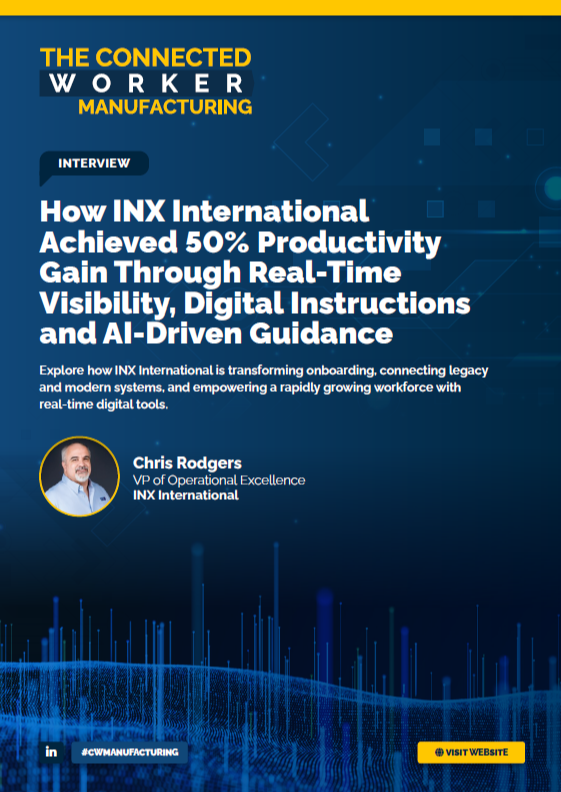
How INX International Cut Operational Inefficiency by 50%
INX International is unlocking a 50% productivity gain in critical changeovers with connected worker and smart manufacturing technology, no overtime required. Led by Chris Rodgers, VP of Operational Excellence, real‑time visibility and AI‑driven execution are delivering repeatable results across mixed‑generation plants.
In this exclusive interview, you'll learn how INX International:
- Uses real‑time operational visibility to lift throughput and reduce bottlenecks
- Applies AI‑guided execution to cut changeover time, errors and variability
- Scales integrated digital systems to boost productivity without increasing labour hours
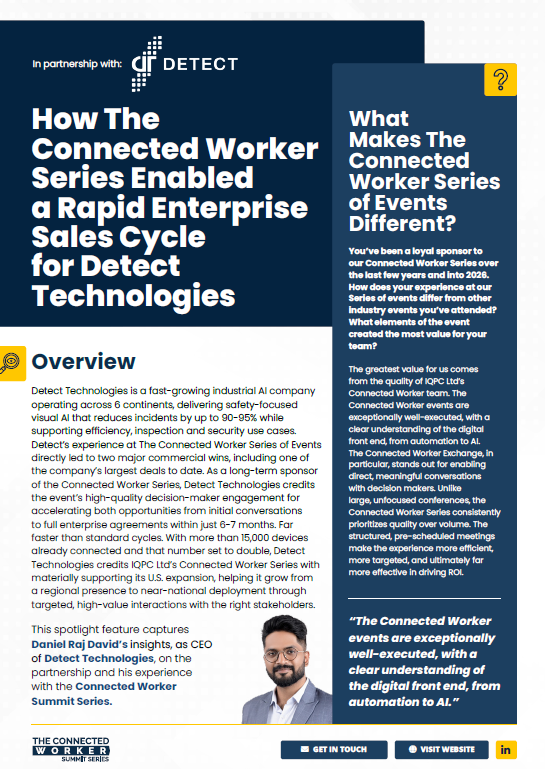
How The Connected Worker Series Enabled a Rapid Enterprise Sales Cycle for Detect Technologies
The Connected Worker Summit Series enabled Detect Technologies to accelerate enterprise sales, unlock stalled pipeline and scale nationally through focused, high‑care engagement.
In this Sponsorship Spotlight you will learn how:
- One of Detect Technologies' largest deals was directly generated through The Connected Worker Summit Series
- Enterprise sales cycles were cut to 6-7 months, accelerating multiple enterprise agreements
- Detect Technologies rapidly scaled U.S. deployment from regional to near-national through targeted enterprise access
- The Connected Worker Summit Series ensures the right conversations happen - never leaving outcomes to chance
In Partnership With:

QUESTIONS?
Telephone: +1 813-658-2511
Email: enquire@iqpc.co.uk

©2026 IQPC. All rights reserved.