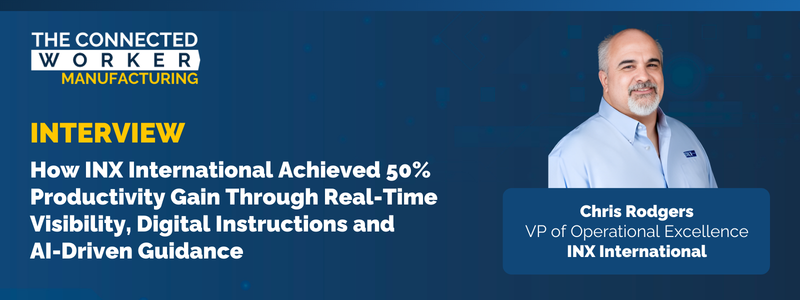
How INX International Achieved 50% Productivity Gain
Save for later - Access the offline version here.
Chris Rodgers, VP of Operational Excellence at INX International, explains how the company is modernizing onboarding, integrating diverse equipment, and enabling real-time plant-floor visibility to accelerate ramp-up and reduce errors. Chris also details INX’s evaluate‑pilot‑scale methodology, which improves safety, reliability, and output while delivering measurable ROI without adding strain to operators or relying on overtime.
Lily Mae Pacey, Industry Analyst: Chris, can you start by describing your role as VP of Operational Excellence at INX International? How does it connect to the organization’s smart manufacturing and connected worker strategy?
Chris Rodgers, INX International: As VP of Operational Excellence, I focus on two areas: connecting our workers to the equipment and connecting that equipment to smarter, more efficient ways to monitor and control our operations. Put simply, my job is to raise the technology level of a very mature company by ensuring both the machines and the people who run them are fully connected. That’s the core of our mission in operational excellence.
Lily Mae Pacey, Industry Analyst: With four connected worker projects in motion, can you walk me through one of INX International's initiatives and explain how it has changed day‑to‑day operations on the plant floor? What measurable impact has INX International seen so far?
Chris Rodgers, INX International: One advantage I have is that I’ve been with the company for a long time, so I know our facilities extremely well and understand how each one operates. That helps when evaluating new technologies because I usually have a good sense of which site is best suited for an initial test.
"If manufacturing doesn’t evolve digitally, we’ll continue to struggle to fill these critical roles."
We typically follow two paths. If technology needs tight integration with our MES or our new maintenance system, we always start at one specific ‘gold‑standard’ plant. They’re best equipped for anything that must connect directly to our existing digital platforms. For tools like AI-powered knowledge and training platforms, which don’t interact with MES, other facilities are often a better fit.
Our general managers meet regularly, and I’m able to sit in on some of those sessions. That’s where I share the upcoming technologies we’re evaluating and ask who has the biggest need and best use case to pilot them. I always welcome their input, but after the success we’ve had with tools like ODEN, Asset Watch, and MaintainX, most sites now volunteer proactively. They’ve seen the impact firsthand.
For me, it’s not only about improving performance, but it’s also about improving the day-to-day experience for our workers. At the sites where we’ve deployed these technologies, we’ve seen clear improvements in employees' perceptions of the work and in our ability to retain new employees. Many younger employees don’t want to work from paper instructions anymore. They’re digital natives. They prefer interactive screens, digital steps, and visual guidance. The more we digitize work instructions, troubleshooting guides, and process orders, which is exactly where we’re headed, the better positioned we are to attract and retain younger talent. If manufacturing doesn’t evolve digitally, we’ll continue to struggle to fill these critical roles...
Join the conversation in Chicago, 2026!
Register your place at The Connected Worker: Manufacturing Summit today and ensure your connected worker strategy is built for the future.